Private · offline · desktop apps for macOS and Windows
A reader, a writer, a diary.
One model, on your machine.
smartreader explains the passage that lost you. smartwriter asks what you meant to write. smartdiary remembers what you wrote down. Each answers with a model that runs on your own silicon — downloaded once, shared by all three, asleep when nobody is asking.
Three promises
Local, once, and quiet.
A model beside the app, not behind a login.
Qwen3.5 runs on a loopback port on your own machine. There is no cloud option to switch on, because there is nothing to switch on.
Three apps, one store of weights.
The apps share one directory of models and one engine. Install a second app and it finds the model already there.
Your GPU is yours while you are only reading.
One server serves all three, keeps at most one model resident, and puts it to sleep after a quiet minute.
The apps
Three surfaces, one habit of mind.
Each is a plain desktop app with the model in the corner: a status chip that says idle, gpu or cpu, and nothing else about it to manage.
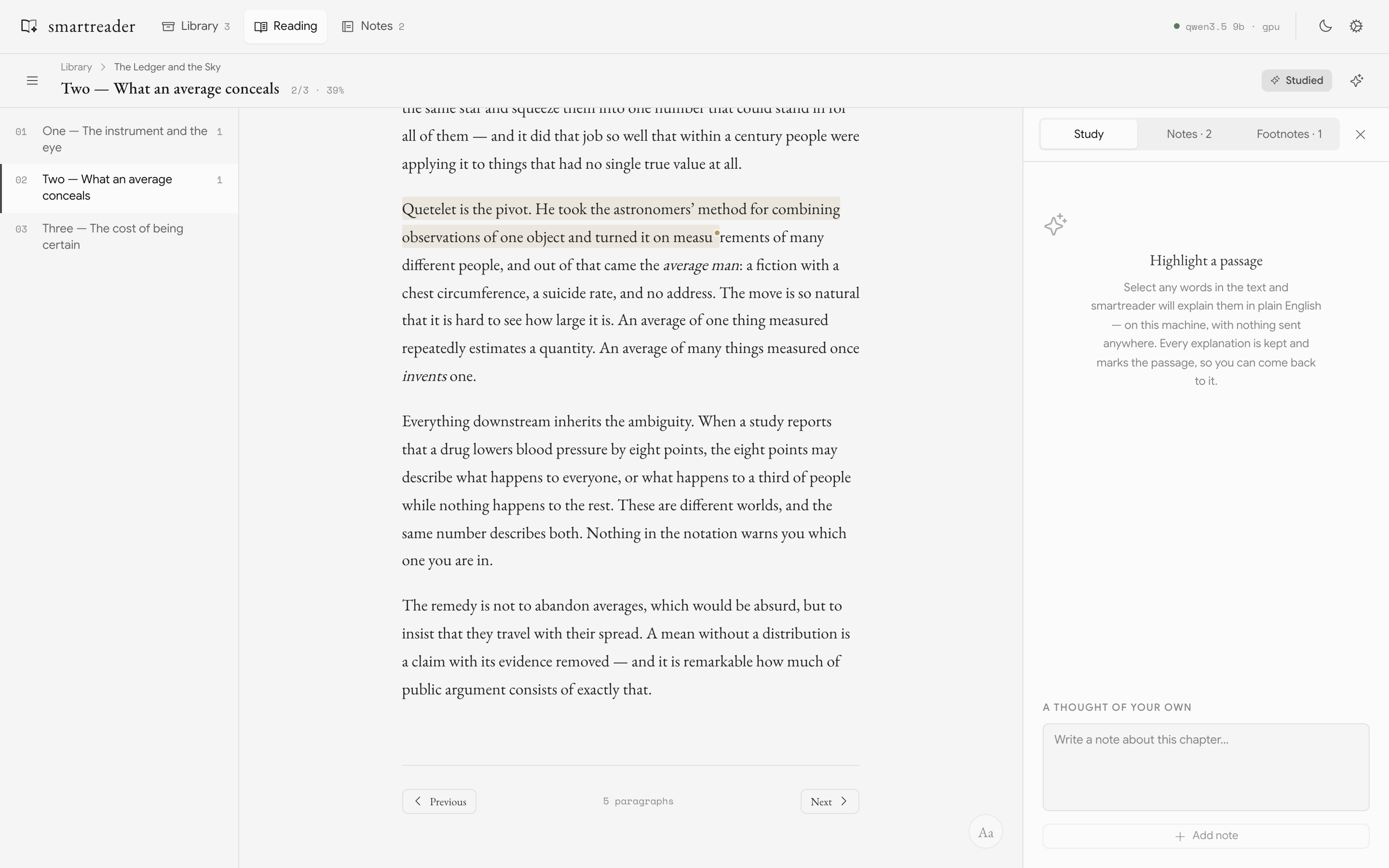
Read anything, and have the hard parts explained in plain English — on your own machine.
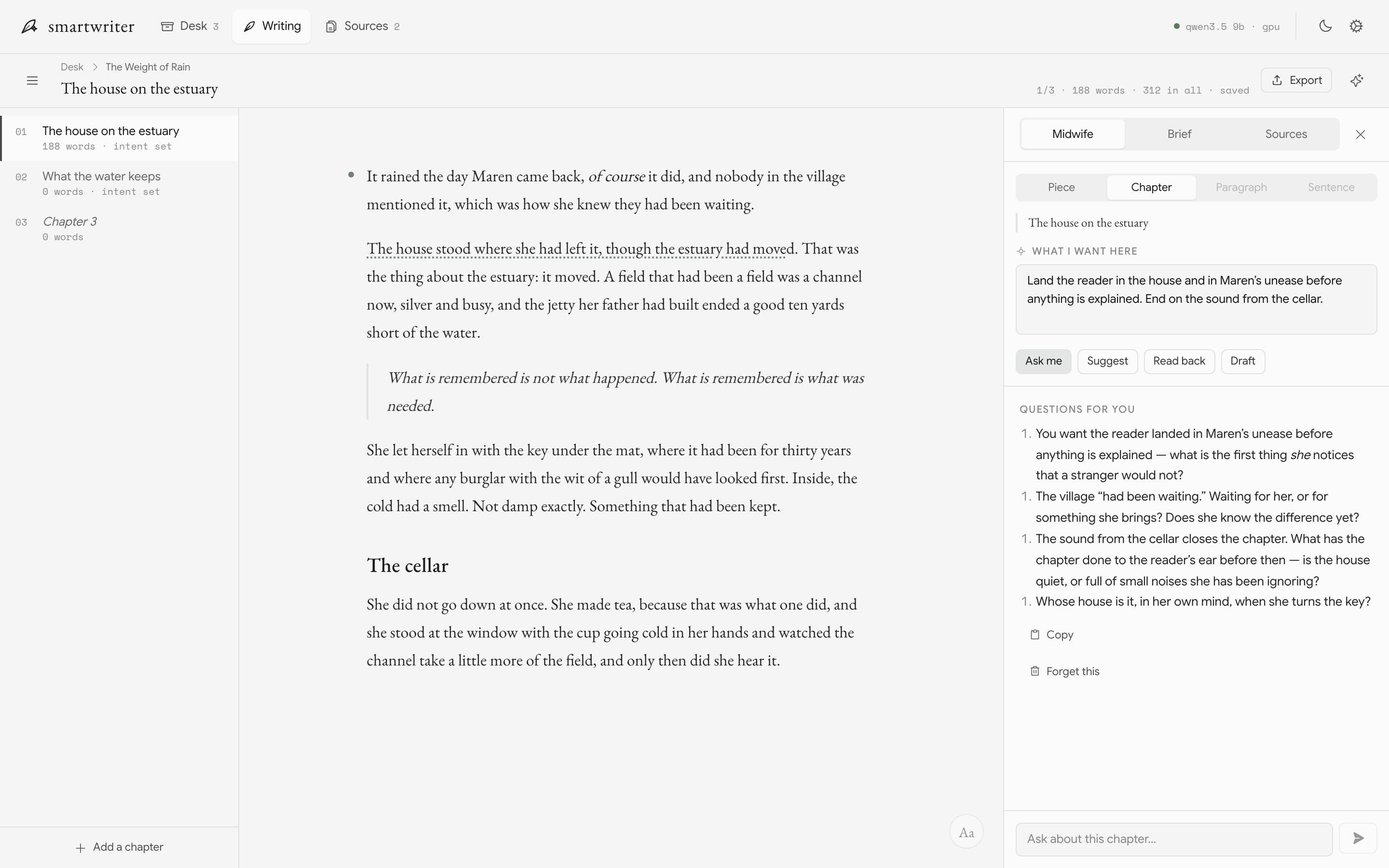
Say what you want to write, and be questioned, directed, read back, or handed a draft — on your own machine.
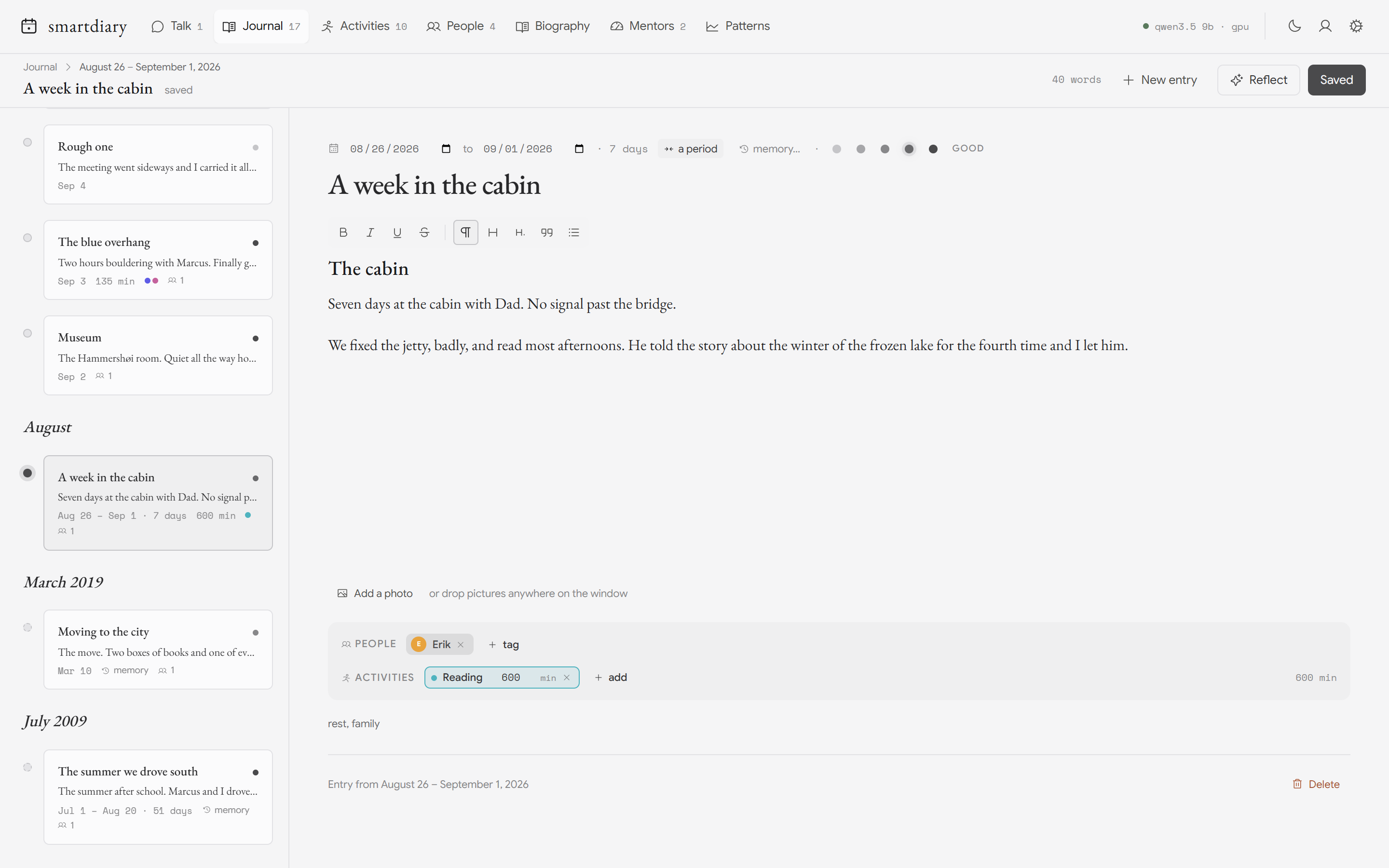
A private diary with a local model beside it: your days, what you did, who was there — everything on your machine.
One runtime for all three
One model on the machine. Whoever asks first starts it.
Every kumulativ app reads and writes the same store: one directory of weights, one llama.cpp build, one running server. Ask smartreader something and the model loads; switch to smartwriter and it is already loaded; leave both alone and a minute later it is asleep.
Whichever app starts the server owns it and takes it down on exit; the next one that asks starts a fresh one. Two apps never hold two models.
Qwen3.5 — 9B where it fits, 4B where it would not — quantised Q4_K_M and sized to your VRAM or RAM.
Chosen once at first run from a hardware probe; a size already on disk is never downloaded again.
Fetched a single time from the model host into the shared store, then cached forever.
16K, set per model in the runtime's preset so every app agrees on how the model is run.
One llama.cpp server in router mode, started by whichever app first needs it and owned by that app.
CUDA on NVIDIA hardware, Metal on Apple silicon, CPU everywhere else — offload sized to the memory actually free.
Loopback only. The port is not reachable from your network, and it is never exposed.
Dies with the app that started it — a Job Object on Windows, so a crash cannot strand it — and the next sibling that asks starts a fresh one.
One kumulativ/ directory under your user config: models, engines, and the registry of the one running server.
At most one model at a time. A second app's model is swapped in on its next question, never held beside the first.
An app that kept its own models before moves them into the store on first launch — a rename, not a download.
A quiet minute and the model leaves memory; the first question after wakes it. The chip in each app says which state it is in.
None. No analytics, no crash pings, no first-run beacon.
None. There is nothing to sign into and nothing that could leak.
Two outbound requests, ever: the engine from GitHub and the weights from Hugging Face, once. After that the apps work with the network off.
smartdiary seals everything under a password only you know. The others keep plain files you can back up by copying.
How it works
From download to first answer in minutes.
No workspace to configure and no invite to wait for. Install one app, let it size a model to your machine, and the next app you install skips that step.
- 01
Install
Download the .dmg or the Windows installer. Open it. That is the whole install.
- 02
First run
The app probes your hardware, picks the Qwen3.5 size that answers quickly on it, and pulls the engine and the weights once into the shared store.
- 03
Ask
Highlight a passage, put the caret in a paragraph, or write the day down. The model loads on the first question and sleeps after a quiet minute.
- 04
Add another
A second kumulativ app finds the store already there. Nothing is downloaded twice, and the two never hold two models at once.
Download
Take them home.
Free. No account, no telemetry. The model is not in the installer — each app fetches it once, into the store they share.
direct downloads · macOS 13+ on Apple Silicon · Windows 10/11 x64, NVIDIA GPUs auto-detected